Showing posts with label War. Show all posts

Sunday, 5 August 2012

The Flowers Of War


I’m surprised that I want to write about Zhang Yimou’s The Flowers Of War. Not because it was bad. Quite the contrary. It’s actually very good. Stunning in fact. But I’m surprised that I’ve chosen to write about this particular war film for the simple fact that it’s not the best I’ve seen, yet something about it has really gripped me, and I can’t stop thinking about it. Yimou, of House Of Flying Daggers and Hero fame has crafted something quite spectacular here.

Based on the novel ‘13 Flowers of Nanjing,’ by Geling Yang, The Flowers Of War tells the story of a group of young Catholic girls trapped in their convent during the “Rape of Nanjing” at the time of the Second Sino-Japanese War. A mortician from the United States, John Miller (played, surprisingly, by Christian Bale) stumbles upon the convent, posing as a Priest to protect the girls, whilst offering shelter to a group of flamboyant prostitutes from Nanjing’s red light district. As Japanese forces conquer the city, Miller vows to get the girls out of Nanjing before they are all killed. The plot sounds a tad ridiculous and I was wary of investing time in it, but Yimou’s war epic makes for fascinating and compelling viewing. 

John Miller (Bale) poses as a Priest to help the convent children.
First off, I have to say the cinematography is breath taking. Chinese film has really pushed the boundaries in recent years, rivalling, even surpassing Hollywood in visual terms. Yimou throws us right into the deep end from the ‘get go,’ plunging us into the heart of battle. The violence never feels gratuitous or melodramatic; Yimou wants to show us the unflinching barbarities of war, its representation one of the best I’ve ever seen. Yimou counteracts this chaos with beautiful, lingering shots of the convent that the girls are trapped in, a safe haven amongst this hell. I particularly enjoyed the transition of steady, sweeping shots in the convent to the shakiness of the handheld camera outside the church walls. Yimou disorientates us when he explores the streets of Nanjing, yet that’s exactly as it should be, and the film is stronger because of it. Maybe this is where Chinese cinema surpasses Hollywood. Yimou is not afraid to show us events that many directors would usually shy away from. The brutality of the Japanese soldiers is played out in front of us in excruciating detail, whether it be the execution of children or the rape of women. There's no holding back here and some of it is incredibly uncomfortable to watch as I'm sure was intended.

I love Yimou’s use of colour. It plays a large role in the film whether it be the dark, dusty greys in war torn Nanjing or the incredible multitude of colours that radiate from the stained glass windows of the convent. Topped off with a simple, haunting and delicate score, The Flowers Of War is a technical triumph.

Prostitutes from Nanjing's Red Light District arrive at the Convent seeking shelter from the invading Japanese.
That's not to say the film is without its problems. Christian Bale has always been a ‘hit or miss’ actor for me. I could rave for hours about his performances in films like The Fighter, American Psycho and Empire Of The Sun yet others like The New World, Reign of Fire and Little Women leave a lot to be desired. Even his portrayal of Bruce Wayne in Christopher Nolan’s ‘Dark Knight Trilogy’ isn’t really praise-worthy. There have always been stronger actors in the Batman films that have reached new heights of brilliance while Bale seems to get left behind. His performance in The Flowers Of War is a mix of both, and I think he’s hindered by the script. Having a high profile Hollywood actor play the part of John Miller is somewhat confusing. Why, I kept asking myself, does he have to be American? Nationality plays a big part in the film as you’ll see if you watch it, yet I don’t think the mergence of Chinese and American cinema is quite as smooth as it could be, and it shows here in some respect. Some of the dialogue between characters is jilted at times as a result of this. Having said that, there are elements of truth here. Americans did, apparently, attempt to help Chinese civilians when it emerged that the Japanese were not attacking ‘Westerners.’ It doesn’t help, of course, that Bale (in my opinion) is once again ‘out-acted’ (if there is such a phrase) by his young Chinese co-stars who turn in some ridiculously good performances as the young convent girls. Special mention must go to Huang Tianyuan and Zhang Xinyi. It must be hard, at a young age, to appreciate the gravity of themes and issues explored in such films, yet these two are totally believable in their portrayal of two girls clinging to survival in war. 

The prostitutes and convent girls meet for the first time.
The arrival of the prostitutes is interesting. Many of the reviews I have read claim that the film’s more pressing issues arrive along with these new characters. I disagree. The group dynamic between the convent girls and prostitutes, the ‘saints’ and the ‘sinners,’ is intriguing to watch and fascinating to explore. Of course, a sub-plot regarding the mutual attraction between John Miller and Yu Mo (Ni Ni) is included and rushed through, which adds unnecessarily to the two hour and twenty minutes run time, yet it’s a small issue.

Yu Mo and John Miller.
Other scenes in the film seem out of place, ridiculous even. Two of the prostitutes, for example, flee the convent and journey to their brothel to gather strings for their instrument so they can play to the dying soldier who they are caring for in their hideout. Another scene where the prostitutes play a song for the convent girls descends into something of a farce and there’s no real place for it in context. I hate to say this, but it’s laughable. By all means, inject humour where humour can be injected, but don’t force it on your audience. The Flowers Of War sets its sombre tone too early on in the film to then throw such strange and weird scenes at us as it heads towards its climax.

The Flowers Of War is quite special. Deep, emotional and thought provoking, Zhang Yimou continues his winning streak here. It’s not perfect, but it’s definitely something you should see. The film only has a 41% approval rating on review site, Rotten Tomatoes, which, quite frankly, baffles me. Many have compared this to City Of Life And Death, another film that deals with similar events. Apparently, it’s superior, although I cannot judge as I have yet to see it. Judging The Flowers Of War on its own merits, however, I can safely say that this comes highly recommended. 

Rating: * * * *


Tuesday, 16 August 2011

Band of Brothers: Ten Years On


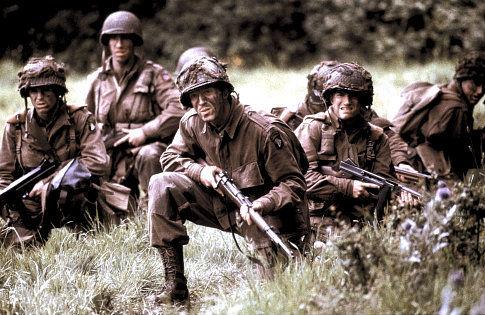
In 2001, HBO screened the stunning, ten part mini-series, Band of Brothers. Clearly inspired by their earlier collaboration on Saving Private Ryan, Tom Hanks and Steven Spielberg reunited to tell the story of Easy Company of the 2nd Battalion in the 506th Parachute Infantry Regiment assigned to the 101st Airborne Division of the United States Army. (What a mouthful!) This biographical account was to be an intimate look at those who fought and died, side by side for their country, and how, in essence, they became ‘brothers.’ Ten years on and Band of Brothers is still as significant as ever; the themes it explores are so very reminiscent of events in Afghanistan and other current war zones. The emotional and physical sacrifices of these men are analysed in heart wrenching detail. It is, quite simply, a majestic piece of television, hardly surprising seeing as it’s a collaboration between HBO and BBC. Balancing ideas of patriotism and heroism alongside the violence, terror and barbarism of war, Band of Brothers is as painfully realistic as a series can hope to get to real events. In fact, it is essential viewing, if only to gain some sort of idea of what the Second World War was like. Yes, some scenes may have been created or exaggerated for dramatic purposes, yet its structure which approaches these men on a personal level, helps us to realise, if not evaluate, just how much these people went through. Ten years on and Band of Brothers is still one of the best war epics ever made.

Human aspects of war take precedence.
I feel strange about calling the act of war a ‘genre.’ Genre is tricky, and something which can trivialize such a delicate subject. Labelling Band of Brothers as a drama seems much more appropriate and something which I believe contributes to its success. This series works because of its timeless nature and I am not talking about the scenario. The focus of this drama is on the men of Easy Company, their lives and how the deal with the situation that they find themselves thrust into. Strip away the breathtaking, war cinematography and we’re left with ideas and themes that we can all identify with. Death, friendship, romance and divorce are explored throughout. There is a yearning on behalf of these characters to find a meaning for their actions, in a war that seems meaningless, at least from their perspective. The writers of The Pacific, a sister series to Band of Brothers use the same approach. Whilst I do not think that it holds the same ‘classic’ status as its predecessor, the quality of the series and the time it spends identifying and analysing its characters, is un-doubtable. Even in Brothers' moments of extreme action, the camera does not indulge in gratuitous and unnecessary violence. Instead, amongst the sweeping battle shots, each director focuses on these men and their core instinct: survival.

Television has become superior to film.
Clear character arch’s can be seen through the series. From Easy Company’s training in England, where the soldiers are raring to fight, to their horrifying experience at the Battle of the Bulge where a substantial loss of life is experienced, we, as viewers, are able to gain an idea, not just of war itself, but of how these people were forced to adjust to war as a way of life. Shifts in mentality because of war is probably the most major point that Band of Brothers successfully hammers across to its audience. We see these men break before our eyes, we see their collapse of human spirit and as such, the pacifist in each of us questions what war can actually achieve.

I suppose this focus on character is where modern war films lose their focus. This, in turn, highlights the genius of television. A ten hour series allows us to identify with these characters; we are able to understand to some degree, the problems they face and the way they think when it comes to every day challenges in the midst of war. Television allows a project a little more room to breathe (an expression I’ve used in a previous post, but one which I stand by). A two hour war film does not. Whilst there is not much that can rectify this problem, the feat of a series is something which has made television superior to film in recent years. Quality television is not hard to come by now and early series’ such as this one can take credit for this newly emerged trend, although this can be saved for another discussion entirely. I do think, however, that war dramas in the present attempt to rise to the heights that Brothers has set. In other words, the approach to Brothers has been a major influence in war films that have emerged in the past decade.

Picking relative unknowns was a smart move on behalf of HBO. Few actors post-Band of Brothers have gone on to do anything mainstream, with a few exceptions of course. David Schwimmer as Sobel is probably the most recognisable due to his role as Ross Geller on Friends, yet ten years on and he has taken more of an interest in directing, than a position in front of the camera. Damien Lewis is probably the most successful out of the ensemble cast (who gel brilliantly together by the way). Yes, we have those cameos from Simon Pegg and James McAvoy, yet their careers have only taken off in the past few years. Rick Gomez as George Luz stands out for me. He, if anything, enforces the idea of Band of Brothers as a ‘human drama’ with the humour that he brings to the show. These lighter moments, away from the chaos of battle, is where Brothers excels, a welcome contrast to the bleak outlook of war and an insightful look as to how these men managed to cope with the seclusion they experienced and their segregation from their families. 

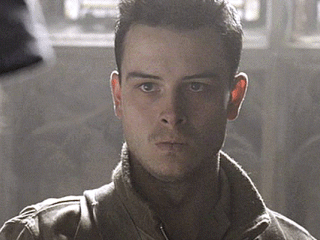
Shane Taylor plays medic, Eugene Roe.
Band of Brothers encompasses the people who helped the war effort, but who would otherwise be forgotten. The medic, Cpl Eugene Roe, played excellently by Shane Taylor, has an entire episode built around him. (‘Bastogne’ is probably one of the best episodes of the series). People like Roe are not those who predominantly feature in films based on war, yet Brothers actively seeks to include them. Moments like these remind us of why HBO’s drama is so great.

Band of Brothers was never meant to be anything ‘political.’ It was a drama that was meant to inform us of how these people fought and died for their country. Brothers premiered on HBO on 9th September 2001. With the 9/11 attacks occurring forty eight hours later, it was somewhat ignored by the public (compared to its popularity now) in a time of crisis. Eventually, however, Brothers found an audience on DVD, and as such has become more significant then ever due to the situation in Afghanistan and Iraq. Brothers, in my opinion, now means more in a post 9/11 world than it ever would have meant pre 9/11. The series is needed, if only to help us catch a glimpse of the human dilemmas that face those deployed oversees, today.

Band of Brothers, I believe, will still be relevant in twenty years time. If you haven’t seen it, watch it, for you are missing out on what is, quite frankly, a masterpiece. As for a complete understanding of war, maybe that is impossible. As Pvt. David Kenyon Webster, played by Eion Bailey, says at the end of episode eight, entitled, ‘The Last Patrol’: “I wondered if the people back home would ever know what it cost the soldiers to win this war. In America, things were already beginning to look like peace time. Standard of living was on the rise. Racetracks and night clubs were booming. You couldn’t get a hotel in Miami Beach it was so crowded. How could anyone ever know the price paid by soldiers in terror, agony and bloodshed if they’d never been to places like Normandy, Bastogne, or Haguenau?”