Thursday, 8 September 2011

Apollo 18

THIS POST CONTAINS MAJOR SPOILERS.
 
Apollo 18 is frustrating. Extremely frustrating in fact. Gonzalo López-Gallego’s ‘found footage horror’ has the potential to be something brilliant, yet in its desire to be something that it’s not, it fails spectacularly. ‘Found footage’ has been done to death, and in my opinion, The Blair Witch Project is the best of the lot, with REC coming a close second. Apollo 18, however, offers something unique, something that in hindsight, could refresh the genre for millions more to enjoy. Its strength lies in its setting: the moon. Immediately it is obvious that these characters will have to endure loneliness, isolation and segregation from humanity. If the film even bothered to tap into these simplistic yet raw themes, it would be an extreme improvement. Unfortunately, everything you want to happen is ignored and what is left is a thin storyline, an attempted horror and plot holes the size of moon craters. (Couldn’t resist. Sorry.)

The premise of the film is actually fantastic, which makes the finished outcome all the more disappointing. Film footage, uploaded to www.lunartruth.com, reveals that the cancelled Apollo 18 mission did in fact launch but never returned, which is why we never went back to the moon. The film, which acts as the material uploaded to the net, uncovers the secrets that NASA has been holding back for years. It’s all very intriguing. The problem lies with the film itself. Multiple sub-plots are stronger than the main story thread, ignored for the most part and only brought back to our attention when they’re conveniently needed. Inextricable problems are suddenly solved without a second thought and the film relies a little too much on the ‘Deus Ex Machina’ plot device to end the character’s dilemmas. It’s dumb and it’s stupid and a great disappointment.
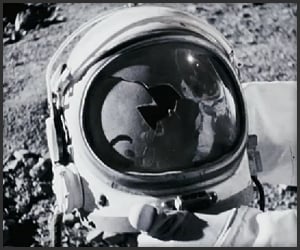
Russians on the moon: One of the better storylines.


Visually, the film is stunning. López-Gallego should congratulate himself on his recreation, but it’s not enough for us to ignore the major flaws that exist here. The film takes an extremely long time to get going, too long for us to feel as if it’s worth investing anything here. When it does, things get interesting. Our main characters find an abandoned Russian landing module on the moon, the inside trashed and covered in blood. This is where Apollo 18 should have focused its energy; as the astronauts communicate with Earth in an attempt to uncover the truth, there is a genuine sense of foreboding and uneasiness. Not surprisingly, this disturbing atmosphere, so expertly crafted, only exists during the more realistic parts of the film, only to dissolve once the idea of an alien creature is introduced. Unfortunately, the Russian story is relegated to a subplot and left forgotten until the very end and there’s no concrete explanation as to why they are actually there. Reasons are hinted at, but for something that is given such prominence at the beginning of the film, the pay off is weak. I’m sure it would be fair to say that Apollo 18 would work far better as a conspiracy thriller. If López-Gallego could think of a legitimate reason as to why the Russians were really there and what happened to them, then this would most likely be something excellent. After all, why does the ‘found footage’ genre always have to revolve around the horrific?

Logic and realism are sacrificed to make a ‘horror’ film that offers nothing new than the one before it. When the good old ‘alien passing outside the window’ scene arrives, it turns out creatures the size of small rocks possess massive shadows that cover the entire lunar landing module. López-Gallego and his team have fallen victim to the horror clichés that dominate the genre these days. This brings me to the biggest plot hole of all, as well as the biggest spoiler. If you’re still planning on watching, I would recommend that you stop reading now and come back later.

All three astronauts die. Any footage that exists is either destroyed in space or left on the moon. We are told at the beginning of the film that, ‘we never went back.’ How, then, did this footage ever get found? I feel as if Dimension Films are really scraping the barrel when their entire marketing campaign (found footage from the moon!) is a sheer impossibility. Are we really meant to believe that this all just found its way back down to Earth? Even an unrealistic explanation would be better than nothing. Ignorance is rife here and it shows.

The casting of three unknowns is a good decision, although their performances are not the best I’ve ever seen. Warren Christie as Astronaut Ben Anderson has the best scenes out of the trio, and he makes the most of the climactic, ‘You’re not coming back to Earth’ scenario. I would be surprised if anyone still cared about these characters by the time their ‘official’ fates are revealed. Apollo 18 is only ninety minutes, yet a long, drawn out beginning makes it feel much longer. As the credits roll over a sombre, piano rendition of ‘We Three Kings’, you will already have pulled apart much of the film’s plot lines. You may also wish you’d spent your £5 on something else. This is one that is destined for the bargain bin when released on DVD and Blu-Ray. No doubt some more footage will have been 'found' by then to bulk out the special features.

Apollo 18 is an extremely predictable story. There’s no substance, no cathartic value. If there weren’t hints of something better in the remnants of an awful horror, then maybe I wouldn’t be so disappointed. It is said that in space, no one can hear you scream. After watching Apollo 18, I don’t think anyone would care.

My Rating: * *


Tuesday, 16 August 2011

Band of Brothers: Ten Years On


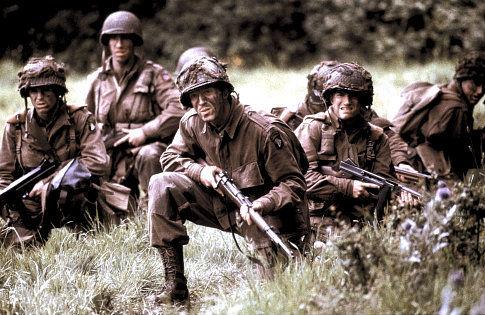
In 2001, HBO screened the stunning, ten part mini-series, Band of Brothers. Clearly inspired by their earlier collaboration on Saving Private Ryan, Tom Hanks and Steven Spielberg reunited to tell the story of Easy Company of the 2nd Battalion in the 506th Parachute Infantry Regiment assigned to the 101st Airborne Division of the United States Army. (What a mouthful!) This biographical account was to be an intimate look at those who fought and died, side by side for their country, and how, in essence, they became ‘brothers.’ Ten years on and Band of Brothers is still as significant as ever; the themes it explores are so very reminiscent of events in Afghanistan and other current war zones. The emotional and physical sacrifices of these men are analysed in heart wrenching detail. It is, quite simply, a majestic piece of television, hardly surprising seeing as it’s a collaboration between HBO and BBC. Balancing ideas of patriotism and heroism alongside the violence, terror and barbarism of war, Band of Brothers is as painfully realistic as a series can hope to get to real events. In fact, it is essential viewing, if only to gain some sort of idea of what the Second World War was like. Yes, some scenes may have been created or exaggerated for dramatic purposes, yet its structure which approaches these men on a personal level, helps us to realise, if not evaluate, just how much these people went through. Ten years on and Band of Brothers is still one of the best war epics ever made.

Human aspects of war take precedence.
I feel strange about calling the act of war a ‘genre.’ Genre is tricky, and something which can trivialize such a delicate subject. Labelling Band of Brothers as a drama seems much more appropriate and something which I believe contributes to its success. This series works because of its timeless nature and I am not talking about the scenario. The focus of this drama is on the men of Easy Company, their lives and how the deal with the situation that they find themselves thrust into. Strip away the breathtaking, war cinematography and we’re left with ideas and themes that we can all identify with. Death, friendship, romance and divorce are explored throughout. There is a yearning on behalf of these characters to find a meaning for their actions, in a war that seems meaningless, at least from their perspective. The writers of The Pacific, a sister series to Band of Brothers use the same approach. Whilst I do not think that it holds the same ‘classic’ status as its predecessor, the quality of the series and the time it spends identifying and analysing its characters, is un-doubtable. Even in Brothers' moments of extreme action, the camera does not indulge in gratuitous and unnecessary violence. Instead, amongst the sweeping battle shots, each director focuses on these men and their core instinct: survival.

Television has become superior to film.
Clear character arch’s can be seen through the series. From Easy Company’s training in England, where the soldiers are raring to fight, to their horrifying experience at the Battle of the Bulge where a substantial loss of life is experienced, we, as viewers, are able to gain an idea, not just of war itself, but of how these people were forced to adjust to war as a way of life. Shifts in mentality because of war is probably the most major point that Band of Brothers successfully hammers across to its audience. We see these men break before our eyes, we see their collapse of human spirit and as such, the pacifist in each of us questions what war can actually achieve.

I suppose this focus on character is where modern war films lose their focus. This, in turn, highlights the genius of television. A ten hour series allows us to identify with these characters; we are able to understand to some degree, the problems they face and the way they think when it comes to every day challenges in the midst of war. Television allows a project a little more room to breathe (an expression I’ve used in a previous post, but one which I stand by). A two hour war film does not. Whilst there is not much that can rectify this problem, the feat of a series is something which has made television superior to film in recent years. Quality television is not hard to come by now and early series’ such as this one can take credit for this newly emerged trend, although this can be saved for another discussion entirely. I do think, however, that war dramas in the present attempt to rise to the heights that Brothers has set. In other words, the approach to Brothers has been a major influence in war films that have emerged in the past decade.

Picking relative unknowns was a smart move on behalf of HBO. Few actors post-Band of Brothers have gone on to do anything mainstream, with a few exceptions of course. David Schwimmer as Sobel is probably the most recognisable due to his role as Ross Geller on Friends, yet ten years on and he has taken more of an interest in directing, than a position in front of the camera. Damien Lewis is probably the most successful out of the ensemble cast (who gel brilliantly together by the way). Yes, we have those cameos from Simon Pegg and James McAvoy, yet their careers have only taken off in the past few years. Rick Gomez as George Luz stands out for me. He, if anything, enforces the idea of Band of Brothers as a ‘human drama’ with the humour that he brings to the show. These lighter moments, away from the chaos of battle, is where Brothers excels, a welcome contrast to the bleak outlook of war and an insightful look as to how these men managed to cope with the seclusion they experienced and their segregation from their families. 

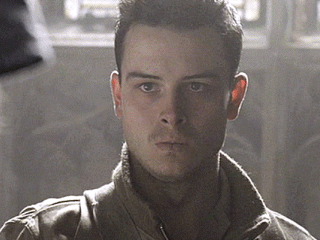
Shane Taylor plays medic, Eugene Roe.
Band of Brothers encompasses the people who helped the war effort, but who would otherwise be forgotten. The medic, Cpl Eugene Roe, played excellently by Shane Taylor, has an entire episode built around him. (‘Bastogne’ is probably one of the best episodes of the series). People like Roe are not those who predominantly feature in films based on war, yet Brothers actively seeks to include them. Moments like these remind us of why HBO’s drama is so great.

Band of Brothers was never meant to be anything ‘political.’ It was a drama that was meant to inform us of how these people fought and died for their country. Brothers premiered on HBO on 9th September 2001. With the 9/11 attacks occurring forty eight hours later, it was somewhat ignored by the public (compared to its popularity now) in a time of crisis. Eventually, however, Brothers found an audience on DVD, and as such has become more significant then ever due to the situation in Afghanistan and Iraq. Brothers, in my opinion, now means more in a post 9/11 world than it ever would have meant pre 9/11. The series is needed, if only to help us catch a glimpse of the human dilemmas that face those deployed oversees, today.

Band of Brothers, I believe, will still be relevant in twenty years time. If you haven’t seen it, watch it, for you are missing out on what is, quite frankly, a masterpiece. As for a complete understanding of war, maybe that is impossible. As Pvt. David Kenyon Webster, played by Eion Bailey, says at the end of episode eight, entitled, ‘The Last Patrol’: “I wondered if the people back home would ever know what it cost the soldiers to win this war. In America, things were already beginning to look like peace time. Standard of living was on the rise. Racetracks and night clubs were booming. You couldn’t get a hotel in Miami Beach it was so crowded. How could anyone ever know the price paid by soldiers in terror, agony and bloodshed if they’d never been to places like Normandy, Bastogne, or Haguenau?”


Saturday, 13 August 2011

Rise of the Planet of the Apes

THIS REVIEW CONTAINS MINOR SPOILERS

Andy Serkis recently stated in an interview that motion capture is like make-up. The actor acts and the visual effects are applied later. At first I was a little reluctant to embrace this view. Then I saw Serkis' performance in Rise of the Planet of the Apes, the latest ‘reboot’ to hit our cinema screens, brought to us from British director, Rupert Wyatt. Forget James Franco or Freida Pinto. Serkis is the star here and it’s time that motion capture was recognised as a legitimate form of acting. Surely Serkis will receive some sort of recognition for his performance. It is, quite frankly, the best use of motion capture that Weta Digital has ever put onto film, beating even that of James Cameron’s Avatar.

Serkis plays Caesar, an orphaned chimpanzee with enhanced intelligence, made possible through the testing of a genetically engineered retrovirus applied to his mother. As scientist Will Rodman (James Franco) battles to find a cure for Alzheimer’s disease, he becomes increasingly ignorant of the repercussions that his experiments are having on his test subjects. Soon, the battle for supremacy begins as Caesar leads the rebellion against humanity.

Apes is driven by character, saving its action for the third act. This, of course, is part of its brilliance. Caesar’s life is documented by Wyatt in documentary type style before unleashing the uprising that is teased throughout. Indeed, the title for the film was originally Caesar before Twentieth Century Fox changed it to be a recognisable instalment in the well known franchise. (The less said about Tim Burton’s remake the better).

Serkis is terrific as Caesar.
I cannot praise Serkis’ striking ability to bring an emotional, three dimensional depth to a character that is visually made up of CGI, enough. Serkis’ genius resides in his eyes. In essence, they betray his character’s emotion when compared to the misleading façade that Caesar attempts to demonstrate to his human counterparts. His confusion at his mistreatment, his yearning for the safe haven he has learned to call home, his thought process and hatred of his enemies is all portrayed through his eyes. It is an incredible performance, and once again I shall reiterate the need for motion capture to be recognised at some of the more prestigious award ceremonies. You only need to catch a glimpse of the trailer to see what I mean. Human antics are present within Caesar; interesting questions about the bonds between the animal and the human and the boundaries between them are posed whilst the ethics, the moral philosophy and the wrongs of animal testing are also hinted at. It is, however, only a slight hint. Wyatt stops short of plaguing us with the political messages that he could easily promote in a film like this.

Rise of the Planet of the Apes is a drama and not, I would argue, the action film that the premise implies. The tension builds, at times, to unbearable levels and the turning point, the game changer of the film, where Caesar embraces his Spartacus-esque position as the rebellion’s leader is a fantastic, shocking, gritty and raw moment. “Take your stinking paws off me, you damned dirty ape!” Tom Felton’s character screams at Caesar as the tables turn and the animals rise to dominance. “No!” Caesar shouts back, the first words spoken by the ape. This is drama at its best, executed perfectly and a nostalgic look back at the quote made famous by Charlton Heston in the original film. (I'm pretty sure the audience gasped here, such is the intensity). Many viewers looking for cheap thrills may prefer less time spent on Caesar’s hardships and more time dedicated to the action, most prominently the stunning final battle that takes place on the Golden Gate Bridge. Quite rightly, however, this is not the case.

James Franco puts in a disappointing performance.
The human cast is what prevents me from giving this film a perfect five stars. Franco has little to do in the final hour. We catch quick glimpses of him running around looking for his former chimp friend but his performance is disappointing, especially after his turn in Danny Boyle’s 127 Hours. Freida Pinto, last seen in Slumdog Millionaire (another Boyle film) is dull at best and brings nothing new to the table while Brian Cox just looks bewildered for the majority of his screen time. Tom Felton has a little too much Draco Malfoy in him for his performance to be taken seriously but in all honesty, it is hard to overshadow Serkis. Indeed, the 'ape only' scenes are some of the best that the film has to offer. John Lithgow, however, is heart breaking in his portrayal of a father afflicted with Alzheimer’s. Wyatt handles the subject tastefully and with sincerity. It is interesting that he includes the degradation of the human mind against the evolution of the ape’s intelligence. Symbolic? Yes. Gratuitous? No. Apes, at its core, deals with a son trying to save his father. It revolves around one man who attempts to achieve the impossible whilst trying to deal with the repercussions of his hubristic nature.

I hoped for a shot of a post uprising world yet Wyatt does not humour us with such events. This is only the rise of the apes and not the complete take over. One of the last images of man and ape standing side by side is an iconic one, and leaves the viewer to image what will happen next. Yes, the original films tell us what will occur in the far future, yet I cannot help but think that there is a missing chapter in between this prequel and the first film of the classic saga that will link all of the chapters in a definitive way. If there isn’t, it’s one hell of a jump, even with the scene that plays over the end credits, of which I shall not spoil.
  
Many have raved about this film. Some of the praise I find a little excessive. This isn’t a classic but along with Super 8, Rise of the Planet of the Apes is one of the better summer blockbusters to hit our screens this year. Terrifying, touching, emotional and raw, Wyatt’s film is essential viewing, if only to see how it pays homage to the original. I enjoyed it and I believe Fox will turn this into their next summer franchise. Expect sequels.

My Rating: * * * *

Friday, 29 July 2011

Captain America: The First Avenger

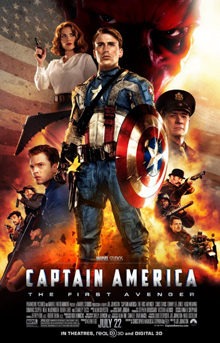
I have to admit, I wasn't expecting much from Marvel's latest blockbuster. For starters, I know absolutely nothing about the character (only that he was introduced to American audiences during the Second World War in an attempt to boost public morale). I also believed that Captain America: The First Avenger would act as one long trailer for the much anticipated Avengers film, arriving next summer (in the same vein as Iron Man 2). How wrong I was. True, there's nothing deep about Captain America; it embraces its patriotic roots and plays off its propaganda beginnings. There's no self doubt or inner demons plaguing our hero here. For once, it's all about the fun and Captain America excels in it. It's no Dark Knight but it certainly outshines 2011's other super hero flicks: Thor and X-Men: First Class, both of which I thought were brilliant. 

The First Avenger follows Steve Rogers, a boy desperate to join the army and help fight for his country in the Second World War. He is soon transformed into a super soldier, becoming Captain America, supporting troops oversees before he himself is plunged into the midst of battle, attempting to stop Red Skull, Hitler's head of weaponry, from using a tesseract energy source for world domination. Yes, the plot is preposterous, but it really doesn't matter. Captain America was created to promote America, and that's exactly what the movie adaptation does. In fact, I don't think I've ever seen so many stars and stripes in one film.

I believe Thor and Captain America work because of their uniqueness. They break the mould, if you will, of the generic super hero movie that we are all now accustomed to. Iron Man, Spider Man, even The Dark Knight to some degree, (although in no way am I criticising the latter) all take place in a city location. Frankly, it's beginning to get tiresome. The majority of Thor, however, takes place in the mythical world of Asgard, while Captain America takes place on the front line of World War II. It's a refreshing take on something that's been done thousands of times before. On that note, director Joe Johnston has done a terrific job of mirroring the streets of forties New York. This could, in all honesty, be your typical war drama. 

Chris Evans, after his disappointing, if not disastrous turn as the Human Torch in Fantastic Four, is perfect for the role of Captain America. I suppose, in hindsight, it was Evans who encouraged my reluctance to see the film in the first place. After all, it would be so easy to turn Cap into the cheesy, gimmicky joker that Evans played in one of Marvel's worst film franchises. There's no need to fear. The action is fun, but there are moments of seriousness that allows Evans to actually act. The Human Torch, truthfully, was a very two dimensional character. Surprisingly, Captain America is one hero who doesn't mind killing people; this is war after all. (One particular scene with a propeller comes to mind. Nasty.) Hugo Weaving as Red Skull brings nothing particularly interesting to the role. He does, at times, embrace the awful cliches that seem to epitomise Hollywood's portrayal of evil. It's a shame, but the film's positives outweigh these minor criticisms. Even the film's supporting cast, Stanley Tucci as Abraham Erskine, for instance, is brilliant. Credit must also go to Hayley Atwell as love interest, Peggy Carter, a Brit who holds her own amongst the film's strong, American cast.

It'll be interesting to study Cap's character arch in The Avengers. After all, his transition into the present could surely be a premise for a whole other sequel. It's almost a shame that Evans has to sacrifice his screen time in order to make way for the others. Maybe Captain America 2 before The Avengers would have made more sense. I will, however, reserve complete judgement on this until I see The Avengers. 
 
‘A weak man knows the value of strength and compassion,’ Tucci mutters to Evans during the course of the film. This is very much the theme of the movie. Captain America: The First Avenger won't win any major awards, but it will entertain the child inside of you, and, if you can stomach Alan Silvestri's overwhelming, patriotic soundtrack, you may leave the cinema feeling very satisfied indeed. Remember to stick around for a post-credits trailer for The Avengers. 
 
"You know what?" I said to my friend, who attended the same screening. "I'm no comic book nerd, but that just got me very excited." Congratulations Marvel. You've set everything up for The Avengers very nicely. Very nicely indeed.
 
My Rating: * * * *

Tuesday, 26 July 2011

Game of Thrones: Season One


THIS REVIEW CONTAINS MAJOR SPOILERS

“When you play the game of thrones, you win or you die. There is no middle ground,” Cersei Lannister spits at Ned Stark in HBO’s adaptation of George R.R Martin’s epic. Truer words were never spoken. I suppose I must congratulate HBO on actually pulling it off. The sheer volume of Martin’s first instalment is enough to dissuade any producer from taking on such a burden, yet David Benioff and D.B Weiss have ruthlessly plucked chapter one of A Song of Ice and Fire and turned it into Game of Thrones. To the untrained eye, Thrones is fantasy, yet this is a presumption that needs to be cast aside. Benioff’s and Weiss’ adaptation is a tale of politics and power play, set in Westeros, a quasi-medieval world that visually resembles our own history. As such, there are hints of realism here. This could be, dragons and pet dire-wolves aside, a historical drama depicting the feud between three families that revolves around the Iron Throne. 

It’s impossible to sum Game of Thrones up into a coherent paragraph that’s a viable length for a blog. I will, however, have a go. It’s all about power. Having it, wanting it, in some cases even lusting over it. Three feuding families, the Lannisters, the Starks and to a lesser extent, the Targaryen’s, fight for the Iron Throne, the one thing that will give them the power they desire so much. Game of Thrones truly is devastating; the advantages of such power are highlighted to a degree by King Robert Baratheon in, of course, the most crass way possible. “I just want to drink myself to an early grave and f**k girls,” he says, or something to that extent. Yet the repercussions of such power is when Game of Thrones really gets going. Families are torn apart by dividend loyalties, tyrants become rulers and dark secrets lurk around every corner. This isn’t just about the magic. This is fantastical opera that rivals even that of J.R.R Tolkein’s Lord of the Rings trilogy. Martin has created an entire universe. Major players of the game of thrones are scattered thousands of miles. Race, religion, sanctions; they’re all here in what has to be one of the most disturbing series to hit our screens this year. 

There’s no real resolution to Game of Thrones’ first season. After all, this is only the first piece of the puzzle. The map during the opening credits (well done Ramin Djawadi on the theme music, by the way) only alludes to the mass expanse of Westeros. There are, I feel, a whole host of places waiting to be explored. (Notice how the opening sequence changes depending on where the action of the episode takes place). One thing I must comment on is the closeness to the book. I’m astounded Benioff and Weiss have managed to stick to the original text with such detail. The ten hour adaptation gives Game of Thrones a little more room to breath. Had this been a two hour film, Martin’s genius text would have been massacred.

Game of Thrones succeeds because of character. It’s the one thing that drives the plot and it’s the better off for it. If anything, Game of Thrones is centred around humanity with all its perfections and, of course, its imperfections. There are no heroes or villains; the Starks, I suppose, are the ones we are meant to root for, yet even they possess dark motivation that blows any morality out of the water. We perceive the Lannisters as the ‘villains’ yet Cersei, the King’s wife, is purely motivated to do the things she does in order to hide her affair from the husband that never truly loved her. Acts of desperation can be misconstrued as acts if bitterness and revenge, but in Westeros, it is every man (and woman) for himself.

Sean Bean is fantastic as Ned Stark, and I won’t waste my time writing about the legend that is Peter Dinklage (Tyrion Lannister), who emerges as the fan favourite. For me, however, it is Emilia Clarke as Daenerys Targaryen who really shines. Exiled as a young girl, after a coup on behalf of Robert Baratheon sees her sadistic father overthrown, Daenerys is thrust into an arranged marriage by her brother who yearns for his rightful place on the Iron throne. Clarke, a relative unknown, is simply superb in her subtleness. For her, the events of Game of Thrones are a journey that sees her grow into a ‘Khaleesi’, or Queen, in her own right. Many have overlooked the Targaryen plotline. If you have, I implore that you go back and take another look. Clarke could well emerge as the star of Game of Thrones and rightly so. If anything, I’m rooting for her to get the throne. It will be interesting to see how she develops during the second series, which will, of course, be an adaptation of Martin’s A Clash of Kings. 

Visually, Game of Thrones is incredible. Weiss and Benioff really use medieval Europe as their inspiration, avoiding the fantasy clichés that dominate most pictures. The effects really are astounding. Every second counts. High sweeping scenes of Westeros (which is actually Northern Ireland and Malta) seem to relish in the beauty of such scenery. Winterfell, Lord Stark’s home, is the epitome of bleakness. At times, there is a translucency to the backdrop of this place, a cold, hard outlook that represents the harsh winter, a stark (pun intended) contrast to the rich and warm colours of the Baratheon household. Game of Thrones’ cinematography is stunning in detail. Maybe some of it is lost on a television screen. This is where my interest is piqued as to what the visual would be on a cinema projector.  

Needless to say, Game of Thrones’ first season has been both shocking and rewarding. It’ll be interesting to see how an adaptation of the second book goes down. Producers have already confirmed that the very long Storm of Swords (which will be Game of Thrones’ third season) will depart from the book, a move that  has been given a negative response from fans. If you felt as if Game of Thrones was lacking in pace (I don’t know why you would!) and only picked up towards its finale, stick with it. Yes, you may think you’ve seen the biggest shock the show can offer (end of episode nine, anyone?) but there is plenty more where that came from. *Cough* Red Wedding *Cough*. Fans of the book will know what I mean. Fans of the television show will have to wait. One thing is certain, however. Season two is going to be one hell of a ride. I, for one, cannot wait until play resumes.


Sunday, 24 July 2011

Mildred Pierce (HBO)

THIS POST CONTAINS MAJOR SPOILERS.

Kate Winslet is my favourite actress. Fact. Yes, Titanic made her a household name and dominated the box office for the best part of a year, but her latest performances are the ones worth raving about. Winslet’s Oscar win in 2009 for her portrayal of Hanna Schmitz in Stephen Daldry’s adaptation of Bernhard Schlink’s The Reader was rightly deserved as was her double Golden Globe win, one of which went towards her work in Revolutionary Road as April Wheeler. Two years later, after a much deserved break, Winslet is back, starring in the HBO mini-series adaptation of James M. Cain’s hardboiled novel, Mildred Pierce. Winslet’s decision to return to the screen in an intimate and small, television project is a genius career move. After all, over-exposure can be dangerous in Hollywood. Winslet now has the freedom to appear in a smaller projects that still demonstrate her stunning acting abilities. Winslet has been nominated for an Emmy. Quite right I think, as Mildred Pierce, quite frankly, is one of the best pieces of television I have seen in a long time and cements HBO’s status as a station that invests in new, exciting and visceral projects.

Mildred Pierce depicts a self-sacrificing mother during the Great Depression, and her struggle to provide for her family after she divorces her husband. Attempting to uphold her family’s status in a world where money is everything, Mildred yearns for the love of her narcissistic daughter, Veda. Heartbreaking, astonishing and totally absorbing, HBO’s five-part adaptation is essential viewing. 

This mini-series, as I understand it, sticks close to Cain’s novel as opposed to the 1945 film noir adaptation starring Joan Crawford. Having only seen the mini-series, I cannot compare although I understand that Crawford’s version turns the story into a murder mystery, something which is both insulting and detrimental to the original text, of which I hope to read soon. Ending more or less the same way as Cain’s book offers Winslet a character arch that is most likely, much more fulfilling as an actress. After all, Mildred’s uprising and the reasons for her spectacular downfall make a fantastic story, without the intrusion of the added murder plot present in the 1945 version. 

I cannot say this enough, but Winslet is fantastic. It is in her subtleness and her quietness that she really shines. I am now convinced that Winslet can turn her hand to anything, such are the range of emotions that she portrays. Her struggle for Veda’s love is painfully realistic as is her bewilderment when she fails to receive this love. If we step back and observe the overall picture, Mildred, regardless of all her success, is just a mother crying out for her daughter. The saying, ‘money can’t buy you happiness’ comes to mind here. Her one aim in life is also her flaw and Winslet conveys the obliviousness of Mildred in a bold and striking manner, her facial expressions a physicality of her state of mind. 

Winslet’s portrayal of Mildred, however, does not come without its criticisms. After all, as one critic states, ‘Cain created a woman of modest roots who becomes obsessed with giving her beautiful, snobbish daughter a better life and discovers a knack for business: Mildred is not long a victim and she isn’t always sympathetic.’ I have not read Cain’s novel, and so I may not be qualified to make such a statement, but for me, I do not think Winslet portrays Mildred as a victim. Yes, she may look the part of the victim, yet as I mentioned earlier, she is totally oblivious as to why she is not earning Veda’s love and so desperately moves on to attend to her daughter’s next whim. She does not have time to be a victim. Only when she discovers Veda’s true intentions does she realise her mistakes and even then she eventually moves on with her life. ‘To hell with her,’ Mildred mutters in the closing scenes of episode five. 

The supporting cast are just as excellent. Guy Pearce as Monty and Evan Rachel Wood as the adult Veda play brilliantly off each other, especially in the last episode where their motives are revealed. Even Morgan Turner as the young Veda oozes hatred and has a fearless and chilling, deceptive quality about her. Maybe it would have been better to introduce Wood earlier in the series. Turner does a fantastic job of getting audiences to sympathise with Mildred, yet the leap in age and time is so sudden that Wood is given the hard task of making us despise Veda all over again, such is the difference. However, she manages to pull it off. Her final scene with Pearce, where Mildred discovers their affair, is gut-wrenching and the slow motion technique only adds to the disorientating revelation. Veda, as a character, is evil, yet deliciously dark in the way she wraps her mother around her little finger.

Along with the 1930s soundtrack and the authentic thirties backdrop, Mildred Pierce is a television series that possesses the qualities of a feature film. This is a feminist period piece, a drama that stands out amongst the reality television that seems to dominate our screens these days. With five, one and a half hour episodes (adverts included), Todd Haynes and Jon Raymond’s screenplay is in no way rushed. While this has drawn criticism from a certain Stephen King who says it’s ‘too damn long’, I have to disagree. Haynes’ remake allows us to contemplate Mildred’s character and her perspective on life. We live the pain that Mildred lives, we feel her desperation and fall as she falls. This is not just a show, it is an emotional experience. Mildred Pierce dabbles in themes that include death, loss, love and hatred. Themes like these cannot be brushed over lightly. Haynes ensures they receive the justice and recognition deserved. 

HBO is fast becoming my favourite station for television shows. Mildred Pierce is quality drama and with the epic Game of Thrones also under their belt, 2011 is looking to be quite a year for them. I watched Mildred Pierce on Sky Atlantic, hence the late review. (It only finished in the UK last night). Shame on Sky for waiting so long in airing this mini-series. Television like this, deserves to be seen.

You can purchase Mildred Pierce on DVD from the US here, or from the UK, here.

Thursday, 21 July 2011

What Happened on the Sanctity Architect

Dev is a refugee. At the age of seven, alien spacecraft appeared above her homeworld and covered it with napalm, burning it to the ground. Thrust into the family’s ship and ferried off the dying planet, she is the survivor of a superior race called the Progenitors’ destructive warning: to leave their artefacts alone.

Twenty years later Dev becomes understudy to one of the scientists on the Faculty ship Sanctity Architect. She has grown up, moved on and buried her frightful past.

But unbeknownst to Dev, her life is about to collide with the Progenitors once again. They destroyed her planet, boiled its atmosphere away, burnt her parents alive – and now they need Dev’s help.
Nicholas J. Ambrose’s What Happened on the Sanctity Architect is a revelation. I, for one, have never been a fan of the science-fiction genre and there are few pieces of literature, if any, that have managed to convince me otherwise. After reading Sanctity Architect, however, I think I’m finally ready to change my mind. After all, it is character and plot that take precedence in Ambrose’s novel. Yes, simple enough, yet whenever I’ve read (or attempted to read) a science-fiction novel, the overall arch of the story is always eclipsed by the author who douses their readers with their knowledge of science, technology and anything else they feel they must include to make their novel part of the genre. Not here. The science in Sanctity Architect rightly plays a supporting role with nothing but characterisation to drive the plot towards its thrilling and devastating climax. 
Gone are the long streams of ‘techno-babble’ that would usually dominate this kind of novel. Ambrose is careful not to segregate any readers, a clever strategy for his debut. Yes, there are moments where character’s conversations revolve around science, yet it is finally understandable. There is great intellect here, yet Sanctity Architect does not insult its readers by containing scientific nonsense that not even the smartest of us can understand. However, Ambrose really shines when the pace picks up. Chapter Three, titled ‘Dev, Dreaming’ is a notable example, containing passages that will terrorize and haunt. The tension that Ambrose creates is at times unbearable, relentless in its ability to continue throughout the majority of the novel. This makes for one gripping finale, although I will not go into that here.
Loss of humanity, for me, is a major occurrence in the novel and it is interesting that Ambrose should highlight this in such a bold way. Indeed, at times he even promotes the loss of human antics as an advantage, this ‘upgrade’ hindered only by Dev’s reluctance to surrender to the ‘norm.’ This is where Sanctity Architect really shines. Although subtle, the idea of what it means to be human packs a powerful punch when we look at the story overall. Conflict arises in the novel as humanity and technology fight for dominance. There are hints of feminist values; Dev stands up for what she believes in, and although her actions inevitably have their consequences, she is a strong character with humanistic morals, a rarity in a world where outer space is oppressive and non-humans (Cam) cherish their patriarchal 'personality.' The best novels are those where characters embark on a metaphorical journey, whether it end with their downfall or their uprising. In an effort to keep this review as spoiler free as possible, I shall not divulge as to which Dev is destined to, yet the change is there, and with it, differences in thematic significance. Although at times it may be seen as a burden, Sanctity Architect, is, essentially, a novel about humanity.
It seems hardly worth it to mention the one criticism I have. It is, after all, a minor blip. Ambrose has a tendency to chop and change scenes in quick succession during the novel. This happens rarely, but when it does, I feel it damages the structure that the author has brilliantly crafted.  It is a literary technique that has been placed there for a reason, yet I prefer the passing of time, more often than not, to be described, rather than an overuse of cutaways and page breaks. Again, it’s only my opinion, and a very minor criticism.
It will be interesting to see where Ambrose goes for his next novel. I will be waiting eagerly for his second book and I anticipate many re-reads of his debut. Totally original, What Happened on the Sanctity Architect is a standout example of what science fiction literature should be about. Heart breaking, action packed and extremely frightening, Ambrose’s novel is one that will stick with you for a long time. 
You can purchase What Happened on the Sanctity Architect for the Amazon Kindle here or in print here. Why not visit the official website of Nicholas J Ambrose for up to date news on his latest releases?